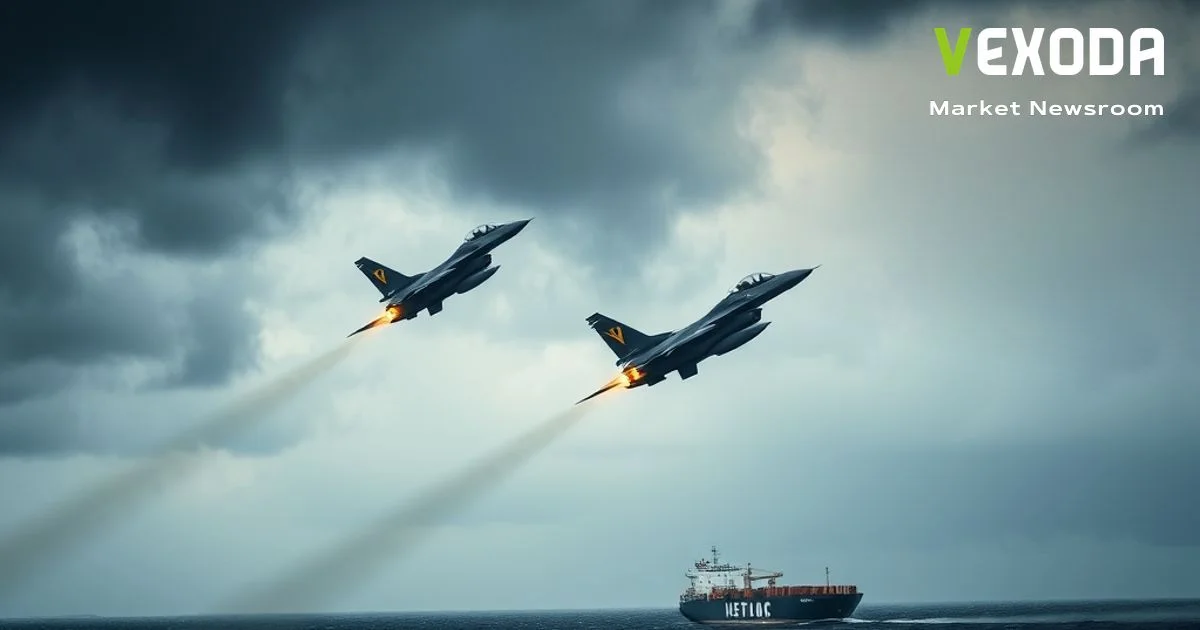
Romanian F-16s Down Drones; NATO Council to Address Black Sea Security

Vexoda Newsroom
Romanian F-16s intercepted and destroyed two drones in its Black Sea airspace, prompting a NATO council meeting to discuss escalating regional security concerns and their market implications.
Romanian F-16 fighter jets were scrambled on Saturday to intercept and destroy two unidentified drones that had entered the nation's airspace over the Black Sea. The Romanian Ministry of Defence confirmed the incident, which occurred approximately 20 kilometers southeast of Sulina. This event marks a significant escalation in regional security, as it involves a direct engagement within the territorial airspace of a NATO member state, raising concerns about the stability of maritime and aerial routes in Eastern Europe.
The operational details reveal a swift response from the Romanian Air Force. The first drone was detected and downed within two minutes of illegally crossing into national airspace at 14:59 GMT, followed by the destruction of a second drone just minutes later at 15:05 GMT. While the origin of the drones has not been officially identified, this incident follows closely on the heels of earlier attacks on commercial shipping vessels in the same waters, suggesting a pattern of escalating threats to maritime traffic and regional security.
The context for this incident is the ongoing geopolitical tension surrounding the Black Sea region, exacerbated by the conflict in neighboring Ukraine. For months, there have been heightened security risks for commercial shipping, including attacks on vessels and infrastructure. The recent drone incursions into NATO airspace, however, represent a direct challenge to the alliance's collective security protocols and airspace integrity, transforming localized threats into a matter of broader international concern.
In the immediate aftermath of the drone shootdowns, the Euro experienced downward pressure in early Asia-Pacific trading, though liquidity was notably thin. The incident, coupled with ongoing civil unrest in France and other parts of the European Union, contributed to a geopolitical risk premium being factored into the single currency. For energy and freight markets, the heightened risk in the Black Sea raises the possibility of increased war-risk insurance premiums and greater caution among shipping operators utilizing these vital trade routes.
The implications of these repeated incursions are substantial. The repeated targeting of commercial vessels and now airspace violations by drones directly threaten the security and economic viability of Black Sea shipping lanes. This raises the specter of increased operational costs for shippers due to higher insurance premiums and potential rerouting, impacting global supply chains. Furthermore, it underscores the vulnerability of NATO's eastern flank and necessitates a robust response to deter future aggressions.
The key event to monitor is the upcoming meeting of the North Atlantic Council, NATO's principal political decision-making body, scheduled for Tuesday. The outcome of this meeting will be crucial in signaling how the alliance perceives these incidents – whether as isolated violations or as part of a coordinated pattern requiring a more assertive collective posture. The collective response, or lack thereof, could influence risk sentiment across European markets and dictate the future security framework for the Black Sea region.
Source: InvestingLive. Summarized and rewritten by the Vexoda Newsroom. This is market news, not financial advice.