German Economy Exceeds Expectations in Q2, Driven by Robust Exports

Vexoda Newsroom
Germany's Q2 final GDP rose 0.3% quarter-on-quarter, surpassing initial estimates. Strong export performance was the primary driver of this upward revision, although domestic demand and investment rem
Germany's economic engine showed a stronger-than-anticipated performance in the second quarter of 2026, with final Gross Domestic Product (GDP) figures revised upward to a 0.3% expansion on a quarterly basis. This growth rate surpassed the preliminary estimate of 0.2%, signaling continued economic momentum from the beginning of the year. On an annualized basis, the German economy grew by 1.0%, indicating a sustained, albeit moderate, recovery in overall economic activity and a positive trajectory for Europe's largest economy.
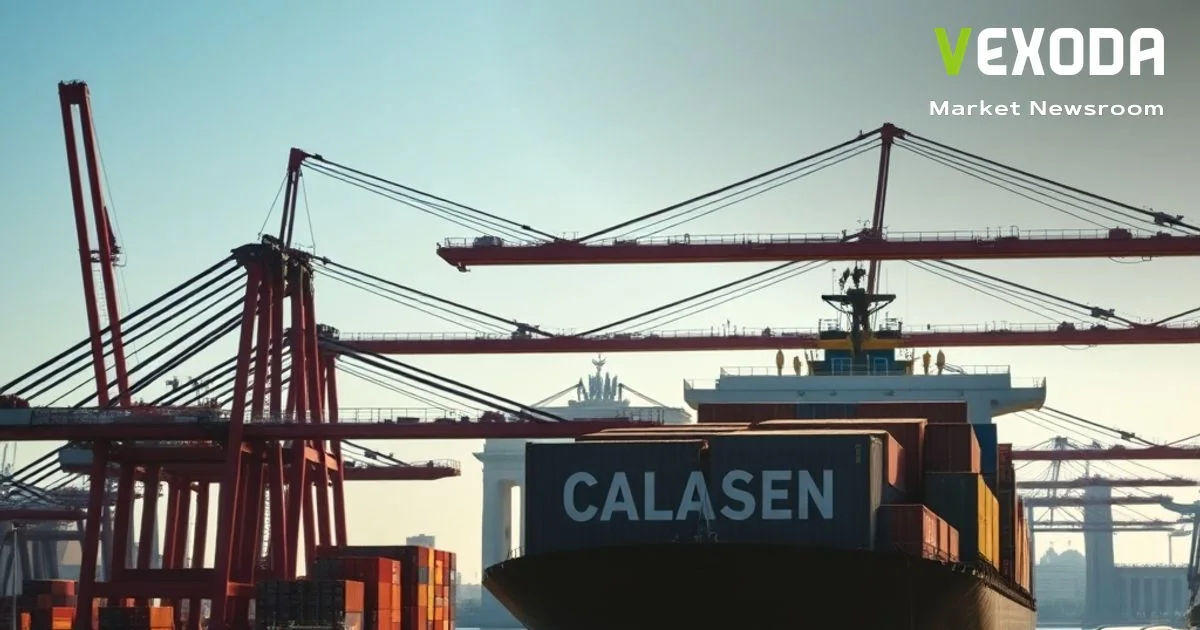
The key driver behind this improved economic outlook was a significant surge in external demand, with exports emerging as the primary engine of growth. Exports of goods and services collectively rose by a robust 2.0% compared to the first quarter. This uplift was led by a substantial 2.6% increase in goods exports, while services exports held steady. Although imports also climbed by 1.5%, the faster growth in exports led to a positive net contribution to GDP, underscoring the critical role of international trade for the German economy.
Several factors contributed to the upward revision of Germany's GDP. Newly released trade data revealed a more vigorous export performance in June than initially assessed. Additionally, wholesale and retail trade activities proved to be stronger than expected during the quarter. The positive trend in exports was further bolstered by high demand for key German products, including chemical goods, advanced electronics, optical products, and vital transport equipment, with trade relations within the European Union showing notable improvement.
Despite the encouraging export figures, domestic economic drivers presented a more mixed picture. Gross fixed capital formation, a measure of investment, saw a slight contraction of 0.2% quarter-on-quarter. Investment in machinery and equipment experienced a more significant decline of 1.4%, while the construction sector's investment grew minimally by 0.1%. This suggests that despite overcoming earlier weather-related disruptions, the construction industry continues to face headwinds, and broader business investment remains cautious.
Consumer spending also contributed modestly to the economic expansion. Both household and government consumption increased by a marginal 0.1% each, indicating that domestic demand is not yet playing a leading role in the economic recovery. Meanwhile, the manufacturing sector demonstrated resilience with a 0.9% output increase, its first annual rise since early 2023, particularly driven by chemical and electrical equipment producers. However, financial and insurance activities acted as a drag, with a 0.7% decline in value added.
The labor market, while showing signs of stress, saw improved productivity. Despite a 0.5% year-on-year decrease in total employment, bringing the workforce to approximately 45.7 million, GDP per hour worked increased by a significant 1.5% year-on-year. This productivity gain suggests that companies are managing to produce more output with fewer resources. Simultaneously, household finances continued to strengthen, with gross wages per employee rising 4.4% year-on-year and net wages climbing 4.7%, potentially supporting future domestic consumption.
Looking ahead, traders will closely monitor whether the positive export momentum can be sustained and if it can translate into stronger domestic investment and consumption. The performance of the manufacturing sector, particularly in key export-oriented industries, will be crucial. Additionally, comparisons with other major European economies, which generally saw higher growth rates in Q2, will provide context for Germany's economic trajectory and its competitiveness within the broader EU market.
Source: InvestingLive. Summarized and rewritten by the Vexoda Newsroom. This is market news, not financial advice.